Erhard Kirschstein (1920–1972): A Berlin Witness in Lithography
Darren and Jane Leno Family Collection, Fargo, North Dakota
I encountered the mystery of Erhard Kirschstein three years ago, at an estate sale in Minnesota, where I acquired two of his hand colored Berlin landmark prints. Investigating these items lead me down a rabbit hole that kept getting deeper and deeper. I found more of his Berlin prints, then regional ethnic German prints, and prints of views of other German cities. Then I began to collect them. I began to look for information on the artist, only to discover there is no monograph on Erhard Kirschstein. No catalogue raisonné, no exhibition record, no entry in the standard reference works on twentieth-century German printmaking. What exists is the work itself — hand-colored lithographs of Berlin that traveled home in the luggage of American servicemen and Defense Department civilians, held in American households for sixty years or more, eventually to surface at estate sales and church rummage tables. This collection began exactly that way: two prints bought at a an estate sale. Several of his prints were widely distributed, and it is likely that right now you can find examples of his landmark work for sale on Etsy and eBay. Prints of other subjects are quite rare, and his paintings rarer still. Taken individually, they may appear decorative, yet their surprising longevity (the latest prints are nearly sixty years old) speak to the quality of their production and the to the appreciation of their holders. Considered as a collection, however, its possible infer a story of an artist reconciling his place in history, a lifetime of first hand observation of a city he saw thrive, then destroyed, occupied, rebuilt, and divided.
What follows is a summary of what can currently be established about the man and his work, with sources given where they exist. Where the record is silent, I have tried to say so and noted the inference. That distinction matters more here than in most artist biographies, because in Kirschstein’s case the secondary literature — such as it is — already contains at least one demonstrable error, and it has been propagated. Since there remains interest in Kirschstein’s work more than a half century after his death, and wide availability of certain prints, I wanted to share what I have learned, and in doing so, hopefully increase awareness of the artist and his work, and lay a foundation upon which other researchers may build.
On Artwork Archive, we have assembled some of the Erhard Kirschstein prints in our collection. An earlier, less complete post we wrote about Erhard Kirschstein can be viewed here.
The Life
Birth
Erhard Kirschstein was born in Berlin on April 20, 1920.
This date is confirmed by two independent primary documents held in this research file:
- The death registration filed with Standesamt Neukölln, Registernr. 3168/72, which records the decedent’s birth date.
- The burial register entry of the Evangelische Kirchengemeinde Berlin-Lichtenrade, provided by the parish office (Küsterei, Goltzstraße 33, 12307 Berlin), which reads: “Kirschstein, Erhard, Kunstmaler, ev., geboren am 20.04.1920 in Berlin.”
A correction to the record: The widely circulated date of April 18, 1920 is incorrect. It originates from the Lichtenrade-Berlin.de community page (compiled with information from Andreas Schulz, a family member) and has propagated from there into secondary listings. Anyone encountering April 18 should trace it back — it will lead to that single source. Two primary civil and ecclesiastical documents agree on April 20.
The church register also confirms his religious affiliation (ev. — Evangelical/Protestant) and gives his occupation in his own era’s terminology: Kunstmaler, art painter. Not Graphiker. Not Lithograf. The prints, on which his surviving reputation entirely rests, were not what the parish clerk — or, one presumes, the family — thought he did for a living.
Parentage, training, and the war
Unknown. This is the largest gap in the record, and it is worth being blunt about its size.
We do not know:
- Who his parents were
- Where or whether he received formal artistic training
- What he did between 1936 and roughly 1951
That last gap is fifteen years wide and covers exactly the war and its immediate aftermath. Kirschstein turned nineteen in April 1939 — prime conscription age, four months before the invasion of Poland. It is a reasonable inference, and nothing more than an inference, that he served in the Wehrmacht. No service record has been located. Personnel records for Wehrmacht service are held by the Deutsche Dienststelle (now integrated into the Bundesarchiv), and an inquiry there is an outstanding item.
Likewise, the technical competence visible in the lithographs — the confident, economical crosshatching, the understanding of how a stone holds a line — strongly suggests formal training. This too is inference. No enrollment record has been found; the Universität der Künste Berlin (successor to the Hochschule für bildende Künste) has not yet been queried.
A professional genealogist has been engaged to pursue the birth record, parentage, training, marriage, and military service. This article will be revised when those results are received.
Marriage
Kirschstein married Charlotte Budek (1924–2013), herself a painter. The marriage is confirmed by the burial register, which names “Ehefrau: Charlotte Kirschstein, Hilbertstr. 25,” and by the Ruhr Nachrichten death notice for Charlotte (November 29, 2013), which gives her as “Charlotte Kirschstein, geb. Budek.” German family-placed death notices are conventionally treated as primary genealogical evidence.
The date of the marriage has not been established. A request for the Heiratseintrag (c. 1946–1955) is pending; the Landesarchiv Berlin has directed the inquiry to Standesamt Tempelhof-Schöneberg.
Charlotte’s son, Werner, may have been born to them, or to a previous marriage.
The studio
Erhard Kirschstein, Hilbertstraße 25b, Berlin-Lichtenrade, Tel. 70 92 43.
A studio stamp is sometimes visible on the verso of a print, which fixes the business at what appears to be a residential address. The presence of this stamp has proven to be somewhat rare, and we hold two examples. The building at the address still stands, a 1950s apartment block in Lichtenrade, in the far southern reach of the Tempelhof-Schöneberg district. A studio stamp bearing a phone number is a retail artifact: it exists so a customer can call back and buy another one.
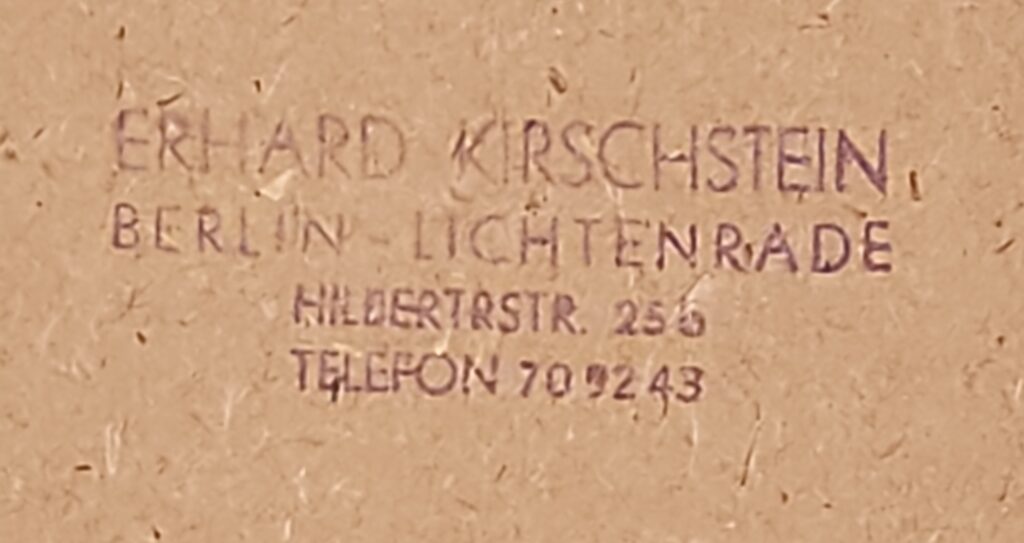
A separate auction record — Hargesheimer Kunstauktionen Düsseldorf, Lot 264 — carries a verso studio label reading “Atelier Erhard Kirschstein, Berlin”, on another artist’s work. Its possible that Kirschstein was able to distribute other artists prints through his distribution network, alongside his own.
Death
The burial register is precise, and the precision is worth reproducing:
Verstorben am 6.11.1972 um 9:45 Uhr, im Krankenhaus Neukölln. Bestattet am 9.11.1972, Erdbestattung, begleitet von Pfr. Röhrborn. Grabstelle: Abt. XV AW, Nr. 62/63. Predigt: Röm. 11, 33 + 36.
He died at 9:45 in the morning on November 6, 1972, in the Neukölln hospital, aged 52. He was buried three days later. Pastor Röhrborn preached on Romans 11:33 and 36 — “O the depth of the riches both of the wisdom and knowledge of God! how unsearchable are his judgments, and his ways past finding out… For of him, and through him, and to him, are all things.”
Erhard Kirschstein’s grave no longer exists. The lease on plot Abt. XV AW Nr. 62/63 expired and the plot was reused in 1997 — standard practice in Berlin municipal and parish cemeteries. Charlotte’s grave at the Alter Parkfriedhof Lichtenrade (Paplitzer Straße 10) remains active, its lease valid until 2037, maintained by a grandson. Whether her stone also commemorates Erhard is an open inquiry with the parish.
Cause of death is not recorded in the documents held. He was 52.
The Work
The medium: lithography, hand-colored
Every confirmed Kirschstein print examined in this collection is a lithograph, hand-colored after printing. There are no plate marks — the impressed rectangular indentation that intaglio processes leave in the paper. Coloring seems to have been done primarily with pencil and in some earlier prints, crayon. We hold examples of both.
This matters because auction houses and dealers routinely describe these prints as “etchings.” That description is a cataloger’s error and should not be repeated. No verified Kirschstein etching exists in the documented corpus. Nor has any offset reproduction been confirmed. The etching description likely occurred because some of the mat framed prints under glass may have been mistaken as intaglio impressions.
Typical image area: roughly 9–10 inches high by 7–12 inches wide, with significant exceptions (see the nocturne below).
Confirmed multiple-plate subjects:
| Subject | Distinct plates confirmed |
|---|---|
| Kaiser-Wilhelm-Gedächtniskirche | 4 (three-state sequence + nocturne) |
| Brandenburger Tor | 4 |
| Funkturm | 2–3 |
| Kongresshalle | 2 |
| Platz der Luftbrücke | 2 |
| Siegessäule | 2 |
Dating the corpus
No Kirschstein print in this collection carries a production date. Dating must be done by internal evidence — what is depicted, and when it could have been depicted.
Fixed anchor points:
- 1943 — the Gedächtniskirche is bombed. All ruin compositions post-date this.
- 1951 — the Luftbrückendenkmal is erected, the first major monument of postwar West Berlin. The Luftbrücke prints post-date this. This is the earliest plausible date for any Berlin monument print in the corpus.
- 1957 — the Kongresshalle opens. Those prints post-date this.
- August 1961 — the Wall goes up.
- 1961 — Egon Eiermann’s hexagonal tower is completed beside the Gedächtniskirche ruin. Every print showing it post-dates this.
- November 1972 — Kirschstein dies. Hard terminus.
Working estimate: an active printmaking career of roughly 1951–1968, with the core Berlin chronicle concentrated 1955–1965. The 1968 end date is an estimate, not a documented fact.
Paper stock as a dating indicator: cream paper appears to correspond to earlier runs, white/standard stock to later ones. This is a working hypothesis derived from correlating paper color with datable content within the collection; it is not independently confirmed and should be treated as provisional.
The “1936” Prints
Several include “1936” in the title, and the prints portray a Berlin dated to 1936 — most importantly the intact, pre-war Kaiser-Wilhelm-Gedächtniskirche, with “1936” included in the title. These are not works of 1936. Kirschstein was fifteen or sixteen years old in 1936. There is no evidence of a professional lithographic practice at that age, and every other indicator places his print production after 1951.
These are retrospective reconstructions, made from memory, of a city that no longer existed when he drew it. The vehicles are period-correct — which is precisely the point. He was old enough in 1936 to have absorbed those streets in detail. The cars are remembered details.
This potentially reframes the body of work. The chronicle is perhaps autobiographical. It is not a survey of Berlin landmarks. It is one man’s account of the city he grew up in, watched destroyed, watched rebuilt, and then watched cut in half — with the earliest chapter reconstructed from memory across a gap of twenty-five years and a war.
That is the argument for calling him a witness artist rather than a souvenir printmaker, and it rests on evidence rather than sentiment.
Signatures and the studio partnership
Two distinct signing hands are present across the corpus.
- Erhard’s hand is tighter and more compressed. It matches the signatures drawn directly into the stone.
- The second hand, presumably Charlotte’s or an assistant, is larger, more open, more fluid. It appears on sheet and mat signatures.
This is a finding based on our repetitive handwriting comparison across the collection, not on professional or documentary evidence, and it is offered as a strong reading rather than proof. Additionally, one print in our collection is dual signed by both Erhard and Charlotte. This evidence supports their business collaboration, as well as provides a reference for distinguishing which artist pencil signed the signature and title to the print.
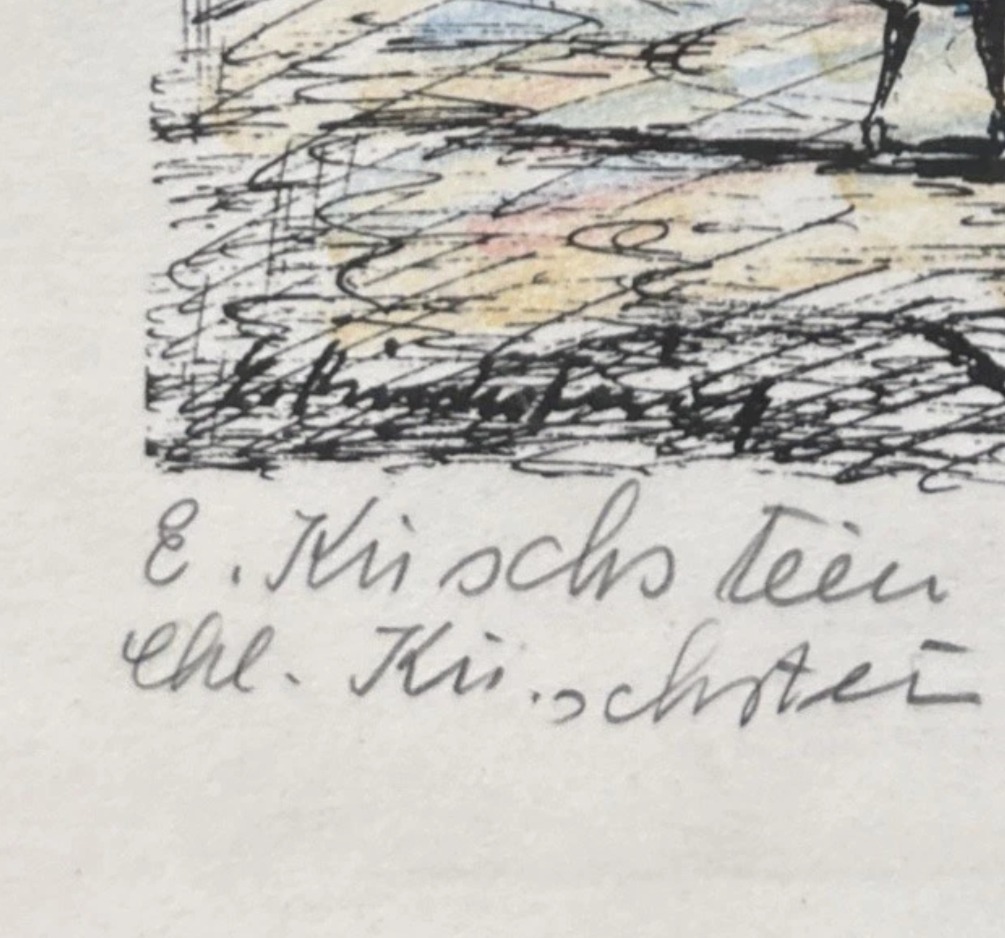
The implication is that Charlotte’s signing was authorized and routine — it was simply how the work left the studio. Her hand on a sheet is a legitimate provenance marker, not a red flag. It suggests a working partnership in which he drew and printed, while the responsibility of finishing, coloring, matting, titling and and signature was a shared part of the collaboration.
We have observed three presentation categories:
- Sheet-signed — signature in pencil on the print sheet margin.
- Mat-signed — signature on the cut window mat. Associated with later commercial distribution.
- Mounted Presentation — the print sheet affixed to a separate cream mount sheet, no window mat, with pencil signature and title on the mount beneath the deckle edge. Confirmed on two prints from a single lot.
An invariable convention, with one exception: across the corpus, hand-colored prints are titled by hand in pencil; the stone carries a signature only. The sole known exception is the horizontal Brandenburger Tor, which is both signed and titled within the plate — “Berlin-Brandenburger Tor” and “Erhard Kirschstein”, his name in full (rather than “E. Kirschstein”). That single print breaks two rules at once (in-plate titling; full given name), and its unusualness is discussed below.
Distribution
Two documented channels:
1. Direct studio sales. Evidenced by the Hilbertstraße 25b stamp with telephone number.
2. Regional retail and framing. Evidenced by framer’s labels on the versos of period framed examples:
- Gebr. Vogl, Augsburg — on a framed Brandenburger Tor. Augsburg is in Bavaria, some 350 miles from Lichtenrade.
- Reus K.G. — stamped “Gerahmt mit reflexlosem Glas” (framed with non-reflective glass), on a third-state Gedächtniskirche. Location not yet identified. Non-reflective glass was a premium option; this is a retail product indicator.
A necessary caution: a framer’s label documents where a print was framed, not where it was sold. A serviceman could have bought a print in Berlin and had it framed after transfer to Bavaria. The Augsburg label is suggestive of a southern German commercial network — particularly since Charlotte’s greeting-card publisher, Plischke-Kunst-Verlag, was also Bavarian — but it is not proof of one.
The American market is documented rather than inferred. The only confirmed institutional holding of a Kirschstein anywhere is at the Phillips Museum of Art, Franklin & Marshall College, Lancaster, Pennsylvania: Summer Landscape with Country Building by Stream with Bridge, oil on canvas, 24½ × 31½ in., object no. 4420, bequest of Estella Elizabeth Cooper Harris — a U.S. Department of Defense schoolteacher who lived in Germany and collected European art (source: eHive museum database). The donor profile is direct evidence of the Allied-community distribution pathway that the rest of the collection only implies.
The painter behind the printmaker
The parish clerk wrote Kunstmaler, and the slowly emerging auction record increasingly supports him.
- Phillips Museum oil (above) — a rural landscape in loose, impressionistic handling, with no connection to the Berlin subjects at all.
- Drei Grasende Pferde — tempera/mixed media, 34 × 74.5 cm, signed “E. Kirschstein” lower right and inscribed “Original-Tempera” lower left, studio label verso. Sold at Hargesheimer Kunstauktionen Düsseldorf, Lot 264.
- Untitled watercolor nocturne of the Ku’damm, c. 1950s — the intact Gedächtniskirche tower illuminated at night amid period signage (Graetz Radio, Marmorhaus, Mercedes-Benz, Opel). Sold via Etsy, c. 2018, for approximately USD 900. Whereabouts unknown. Documented only from the listing photograph.
Interpretation, offered as such: this looks like a dual-track practice of a kind familiar in mid-century German art — serious painting as the “high” work, commercial print distribution as the income and the name recognition. The two tracks are not the same thing, but they feed each other, and the nocturne register in particular seems to cross between them: the watercolor Ku’damm nocturne and the lithographic Kaiser-Wilhelm-Kirche nocturne are recognizably the same sensibility in two media.
The Most Significant Print
Among roughly thirty-five to forty prints documented in this collection, one stands apart.
Berlin – Brandenburger Tor. Horizontal format. Lithograph, uncolored. Signed and titled within the plate — the only print in the corpus that is. Post-August 1961.
And the foreground is void. No people. No cars. The presence of people and motion that characterizes his other landmark work is absent.
Every other Kirschstein Berlin print has street life: buses, trams, pedestrians, dogs, children, wet cobblestones catching reflections, a woman with a shopping basket. He filled his city with the ordinary business of being alive in it, over and over, for fifteen years.
Here, nothing.
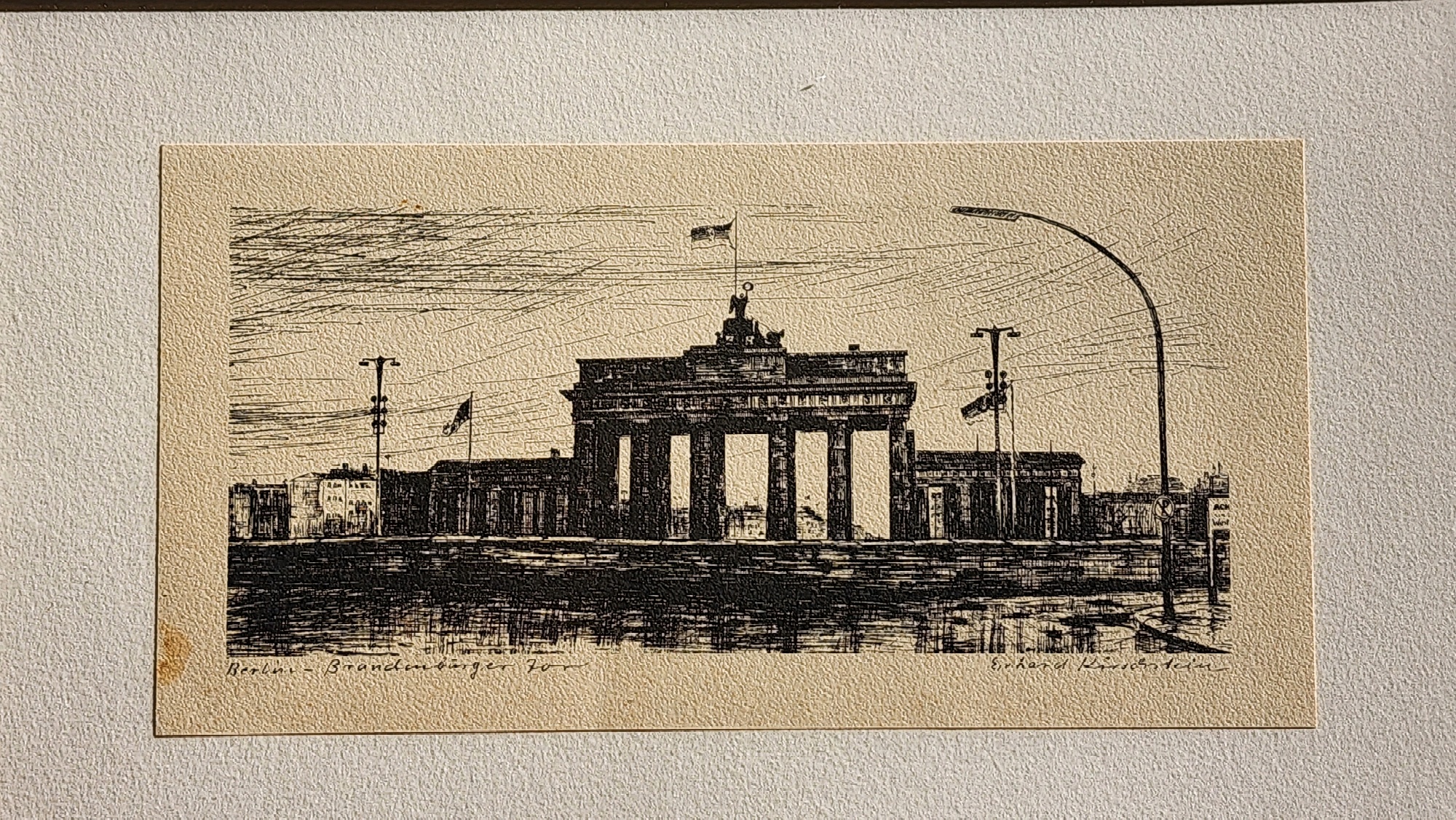
It feels like a stark commentary on the impact of the Berlin wall. In essence, he did not necessarily draw the Berlin all. Rather, he drew what the wall did to Berlin.
Kirschstein left no statement about this or any other print — but it is grounded in observation: the total contrast with his own established practice across every other plate in the corpus. When an artist departs so completely from his own established convention, on the one print he also chose to sign with his full given name inside the stone, the departure is the content.
Follow this link if you would like view some of the Erhard Kirschstein prints in our collection on Artwork Archive.
Known Works — Erhard Kirschstein
In the Darren and Jane Leno Family Collection
Approximately 35–40 prints documented across all series. This list gives the confirmed distinct compositions.
Series 1 — Berlin Monuments and Cityscape
| Work | Medium / notes |
|---|---|
| Kaiser-Wilhelm-Gedächtniskirche, State 1 — intact pre-war church, “1936” inscribed on stone within image | Lithograph, hand-colored. Retrospective reconstruction. |
| Kaiser-Wilhelm-Kirche, State 2 — the ruin alone, c. 1950s | Lithograph, hand-colored. Multiple examples. Finest carries dual signature, Mampe sign with orange awnings, exceptional coloring. |
| Gedächtniskirche, State 3 — ruin with Eiermann tower, post-1961 | Lithograph, hand-colored. Multiple examples; coloring varies widely. |
| Kaiser-Wilhelm-Kirche (Nocturne) — fourth distinct plate | Lithograph, uncolored. Cream paper. Sheet 23.5 × 12.5 in.; image 17 × 7⅛ in. Plate: “E. Kirschstein / Berlin.” Sheet: “Erhard Kirschstein” in full, pencil — the only full-name sheet signature documented. Post-1961. Original brown/mauve mat retained; no acid burn. Acquired eBay (Austin, TX), May 2026. |
| Brandenburger Tor, Plate A — Wall-era, empty foreground | Lithograph, uncolored, horizontal. In-plate title and full-name in-plate signature. Sole instance of in-plate titling in the corpus. Post-August 1961. |
| Brandenburger Tor, Plate B — columnar close frontal, 1950s traffic | Lithograph, hand-colored. Cream paper. Mat-signed. |
| Brandenburger Tor, Plate C — softer tonal variant, open composition | Lithograph, hand-colored. Cream paper. Mat-signed. |
| Brandenburger Tor, Plate D — wet street frontal | Lithograph. Wet cobblestones with reflections, German flag information board, figures crossing. Red flags visible through the gate — the Eastern side, seen from the West. Colored and uncolored states. Plate + sheet signature. |
| Kongresshalle, Composition A — frontal ceremonial view | Lithograph, hand-colored. US and German flags, costumed figures. Post-1957. |
| Kongresshalle, Composition B — oblique park view | Lithograph, hand-colored. Tree-framed. |
| Luftbrücke / Berlin-Tempelhof, Plate 1 | Lithograph, hand-colored. Cream paper. Nazi-era Reichsadler visible on the Tempelhof building. |
| Luftbrückendenkmal, Berlin, Plate 2 | Lithograph, hand-colored. White paper. Tree-framed, mother and child in foreground. Coloring varies from warm amber to cool grey across examples. |
| Siegessäule, Composition A — distant, open | Lithograph, hand-colored. Cream paper, soft impression. |
| Siegessäule, Composition B — closer frontal | Lithograph, hand-colored. White paper. Yellow double-decker bus at base. |
| Funkturm, Composition A | Lithograph, hand-colored. Cream paper, soft/faded — likely earliest pull. |
| Funkturm, Composition B | Lithograph, hand-colored. White paper. Tram prominent. |
| Funkturm, Composition C | Lithograph, hand-colored. Pulled back, fuller tree framing, Deutschlandhalle rotunda behind tram. Likely third distinct plate. |
| Rathaus Schöneberg | Lithograph, hand-colored. 2 examples. Flags on clock tower, Ratskeller sign, 1940s–50s cars. Predates Kennedy’s June 26, 1963 speech. |
Series 2 — Historic German Cities
All signed “E. Kirschstein” lower left, city name lower right. More graphic and energetic linework than the Berlin prints. The series is almost certainly incomplete.
| Work | Notes |
|---|---|
| München | Neues Rathaus with Frauenkirche towers. 2 examples. |
| Nürnberg | Weinstadel/Wasserturm on the Pegnitz. 2 examples. |
| Heidelberg | Castle ruins above the Neckar with the old bridge. 2 examples. |
Series 3 — Deutsche Trachten (Interior Genre Scenes)
Two-figure domestic interior compositions, richly hand-colored. Rare, and more artistically ambitious than the standing-costume-portrait format the series title might suggest. Signed “E. Kirschstein” lower right; region titled in pencil below the image.
| Work | Notes |
|---|---|
| Hessen | Woman knitting, man smoking pipe by a tiled stove. White paper. 2 examples. |
| Schwarzwald | Man with pipe seated, woman with basket standing. White paper. 2 examples. |
Documented Elsewhere — Not in This Collection
| Work | Source |
|---|---|
| Summer Landscape with Country Building by Stream with Bridge — oil on canvas, 24½ × 31½ in. | Phillips Museum of Art, Franklin & Marshall College, Lancaster, PA. Object no. 4420. Bequest of Estella Elizabeth Cooper Harris. Source: eHive. Only confirmed institutional holding. |
| Drei Grasende Pferde — tempera/mixed media, 34 × 74.5 cm | Hargesheimer Kunstauktionen Düsseldorf, Lot 264. Studio label verso. |
| Untitled watercolor nocturne, Ku’damm — c. 1950s | Sold Etsy c. 2018, approx. USD 900. Whereabouts unknown. |
| Frankfurt (Eschenheimer Turm) — lithograph, uncolored, “E. Kirschstein” sheet signature, “frankfurt” penciled title | Auction, March 10, 2024 (WorthPoint record). Extends the Historic German Cities series. |
| Berliner Dom (Ost-Berlin) — lithograph, hand-colored, titled “Dom, Ost-Berlin” | Same March 10, 2024 sale (WorthPoint). First confirmed East Berlin subject in the corpus. |
| Set of four: Rathaus Schöneberg (new composition), Gedächtniskirche ruin (street-level Ku’damm approach), Funkturm (yellow tram), Brandenburger Tor (open foreground, figures with dog, pre-Wall) | WorthPoint, February 25, 2016. Provenance noted as “purchased in Germany right after WWII” — the earliest documented acquisition claim in the corpus, though it sits uncomfortably against the 1951 anchor and should be treated skeptically. |
| Deutsche Trachten, third print — spinning-wheel composition, unidentified region | Documented from an online image; original source (auction, dealer, or private listing) not yet retraced. Outstanding research item. |
Sources
Primary documents
- Standesamt Neukölln, death registration, Registernr. 3168/72 (Erhard Kirschstein).
- Evangelische Kirchengemeinde Berlin-Lichtenrade, burial register entry, November 9, 1972. Provided by the parish office, Goltzstraße 33, 12307 Berlin.
- Ruhr Nachrichten, death notice for Charlotte Kirschstein, November 29, 2013.
- Studio stamp, verso, print in the Leno Family Collection: Atelier Erhard Kirschstein, Hilbertstraße 25b, Berlin-Lichtenrade, Tel. 70 92 43.
- Framer’s labels, versos, Leno Family Collection: Gebr. Vogl, Augsburg; Reus K.G.
- The prints and paintings themselves, examined directly.
Institutional
- Phillips Museum of Art, Franklin & Marshall College, object no. 4420 (via eHive). Full catalog record requested; date, inscriptions, and verso labels not yet documented.
Market records
- Hargesheimer Kunstauktionen Düsseldorf, Lot 264.
- WorthPoint archived listings: March 10, 2024 sale; February 25, 2016 four-print lot.
- Etsy listing (via Pinterest capture), Ku’damm watercolor nocturne, c. 2018.
Secondary — use with caution
- Lichtenrade-Berlin.de community page, compiled with information from Andreas Schulz. Contains at least one confirmed factual error (Erhard’s birth date given as April 18) and conflicts with the Ruhr Nachrichten obituary on Charlotte’s birth date. Treat every claim originating here as provisional until confirmed against a primary document.
In progress
- Standesamt Tempelhof-Schöneberg: marriage record, c. 1946–1955.
- Dr. Cornelia Pohlmann (professional genealogist): birth record and parentage; artistic training; military service; marriage record.
- Landesarchiv Berlin (Viola Schulz): contact initiated.
- Michael Kirschstein, Steverstraße 22, 59399 Olfen: rights holder contact, pending.
What We Still Don’t Know
An honest summary of the gaps, since they are as much a part of the current state of knowledge as the findings:
- Parentage and birth record — no primary birth certificate located.
- Training — no institutional record. The competence is visible; the school is not.
- 1939–1951 — twelve years unaccounted for, including the war. A professional researcher was hired in 2026 to look further into this and is pending.
- The marriage — date and place unknown. Erhard is presumed to be Charlotte’s second husband, but this is unresolved.
- Cause of death at 52 — not recorded in documents held.
- A print publisher — was there one, or was the studio the entire operation? No publisher stamp or water mark has been found on any print.
- The end date — 1968 is an estimate. He may have stopped earlier, or worked until he was ill.
Corrections and additions are welcome, and this file is revised as documents arrive. If you own a Kirschstein print — particularly one with a verso stamp, a framer’s label, or a subject not listed above — the corpus is still being assembled, and a photograph of the back is often worth more than a photograph of the front.
Held in the Darren and Jane Leno Family Collection, Fargo, North Dakota.
Text content is licensed: Creative Commons: CC-BY 4.0
Images may be copyrighted by the artist. Contact us immediately if you suspect an inadvertent copyright violation for any content on this sight. This website is for educational, instructional use only and is not a commercial endeavor.