We decided to add Charlotte Kirschstein to our collection after assembling a collection of prints by her husband, Erhard Kirschstein, and finding evidence of their business collaboration. The idea of two married artists creating a post war life in occupied Berlin with art as their major source of income was and remains interesting to us. Even after Erhard’s death, Charlotte went on to produce paintings on her own for twenty, perhaps nearly 40 years. With prints by both artists appearing regularly on auction sites and selling, there remains interest in their work, even while there was virtually no organized information about them. To remedy that situation, we set out to learn more about both Erhard and Charlotte.
Note on sources and method
This is a working document and will be updated as we receive more information. No monograph, catalogue, or peer-reviewed treatment of Charlotte Kirschstein exists. The published record consists of a brief German Wikipedia entry, a community-history page maintained at Lichtenrade-Berlin.de, a family-authored death notice, and the artist’s signed and dated works themselves. This account therefore rests on primary and quasi-primary documents supplemented by two secondary web sources, both of which derive ultimately from a single family informant (the artist’s nephew, Andreas Schulz) and both of which are demonstrably imperfect: the German Wikipedia entry still describes Kirschstein in the present tense and records no death, and it reproduces an incorrect birth date for her husband (April 18, 1920, against the April 20, 1920 established by two independent civil and ecclesiastical records). Claims below are labelled as documented, secondarily attested, or conjectural accordingly. Where a fact rests only on secondary sources that share a common origin, this is stated.
Origins and early life
Charlotte Kirschstein was born Charlotte Budek in Berlin in 1924. The maiden name Budek is documented by the death notice published in the Ruhr Nachrichten on November 29, 2013, which names her “Charlotte Kirschstein, geb. Budek”; German death notices, drafted by the family or funeral home, function as quasi-primary genealogical records and are treated here as reliable for that fact.
Her birth date is unresolved. Two dates circulate:
- April 7, 1924, given in the 2013 Ruhr Nachrichten death notice, and
- July 6, 1924, given on Lichtenrade-Berlin.de and, following it, in the German Wikipedia entry; project notes trace this second date further to a Berliner Morgenpost feuilleton profile of the 1980s, which has not yet been consulted directly.
Neither is a primary record. The definitive source — her civil birth register entry (Geburtseintrag) — is subject to a statutory protection period and is expected to remain closed until approximately 2034. The present project treats the death-notice date (April 7) as the stronger of the two, on the reasoning that the family who buried her is the more authoritative party; but this is a working preference, not a settled finding, and the two dates should continue to be reported side by side until the civil record can be examined.
Her early residences are documented (Lichtenrade-Berlin.de): before the war she lived in her grandparents’ house on the Alvenslebenplatz in Berlin; in 1948/49 she was at Victoriastraße (since renamed Blohmstraße) in the southern Berlin district of Lichtenrade; and from the 1950s onward at Hilbertstraße in Lichtenrade — the same address associated with her husband’s studio (Hilbertstraße 25b). She spent effectively her entire life in Berlin, and predominantly in Lichtenrade.
Marriage, household, and the parentage question
Charlotte married the Berlin painter and graphic artist Erhard Kirschstein (1920–1972). That Erhard was her second husband is secondarily attested: both the German Wikipedia entry and Lichtenrade-Berlin.de describe the union as her zweite Ehe. Both sources, however, derive from the same informant, and no marriage record, no identification of a first husband, and no account of a first marriage’s end have yet been located. The marriage to Erhard is placed by the collection’s ongoing archival inquiry somewhere in the range c. 1946–1955; a request for the Heiratseintrag has been directed to the Berlin civil-registry system (Standesamt Tempelhof-Schöneberg / Landesarchiv Berlin) and was outstanding at the time of writing.
Charlotte had a son, Werner Kirschstein (1949–2016). Werner’s paternity is not established.
Turn to painting
Charlotte Kirschstein came to painting only after the Second World War, and by a humble route: according to Lichtenrade-Berlin.de she began by decorating old military buttons as home piecework (Heimarbeit). She had no formal artistic training on record, which places her squarely within the tradition of the self-taught, or naïve, painter. Her mature manner is consistently described — in the German Wikipedia entry, on Lichtenrade-Berlin.de, and in the works themselves — as naïve art (naïve Kunst): frontal, flattened, densely populated compositions built from clear outlines and bright, locally applied color, without academic perspective or modelling.
Her documented subjects are Berlin and Brandenburg scenes, commissioned portraits of private houses, and views of nature; the works in the Leno Collection extend this range into specific West Berlin street and café life and, in one instance (see below), into decorative animal subjects.
A separate, and more conjectural, question concerns Charlotte’s role in her husband’s printmaking practice during his lifetime. The collection’s examination of Erhard’s hand-colored lithographs suggests two distinct signing hands — a tighter, compressed hand matching the in-stone plate signatures (attributed to Erhard) and a more fluid, open hand appearing in pencil on sheets and mats (attributed by us either to Charlotte or an assistant). The inference that Charlotte handled finishing, coloring, matting, and retail signing of the prints is plausible and internally consistent, but remains a hypothesis built on handwriting comparison rather than external documentation; it should be presented as such. If correct, it would make Charlotte a working partner in the print enterprise well before her own signed painting career began — but this reading is not yet corroborated by any independent source.
Independent career, 1972–1994
Charlotte Kirschstein’s public exhibiting career began in 1972 — the year Erhard died. The coincidence is documented rather than interpreted: her presence at the Harnack-Haus in Berlin-Dahlem is dated from 1972, and her earliest securely dated independent work in the collection is from 1977. Whatever its cause, her emergence as an exhibiting artist under her own name is bound up chronologically with her widowhood.
Her exhibition record, documented and corroborated across both German Wikipedia and Lichtenrade-Berlin.de, comprises:
- Harnack-Haus, Berlin-Dahlem, where her work was on view from 1972 to 1994 — a two-decade institutional presence and the backbone of her exhibiting life;
- the traditional section of the Galerie Brigitte Wölffer, Kurfürstendamm 206, from 1983 to 1987;
- thereafter the foyer of the Theater am Kurfürstendamm (under Jürgen Wölffer), from about 1987;
- a reproduction of her Weihnachtsmarkt vor dem Berliner Dom in the feuilleton of the Berliner Morgenpost on the first Christmas holiday of 1985; and
- the use of one of her Lichtenrade views by the Berliner Bank in a 1984 promotional brochure marking the reopening of its Bahnhofstraße branch.
Her commercial reach was wider than her gallery record suggests. The Plischke-Kunst-Verlag of Unterwössen (Bavaria) reproduced more than fifty of her motifs as greeting and Christmas cards — documented in both secondary sources. The connection is said to have come about when a Lichtenrade customer admired one of her pictures on display in Frau von Bülow’s shop on the Bahnhofstraße and put her in touch with the publisher (Lichtenrade-Berlin.de). No card examples have yet been located in the Leno Collection or on the secondary market, so the card corpus is at present documented in the aggregate but unexamined in the particular.
Lichtenrade-Berlin.de further reports that many of her pictures left Berlin with Allied personnel and are now dispersed worldwide. If accurate, this parallels the documented American-market distribution of Erhard’s prints and situates both artists within the same postwar souvenir-and-community economy of the divided city.
Documented works
Three works can be described with confidence; a fourth cluster of earlier-cited works should be treated cautiously. More information on the Charlotte Kirschstein works in our collection can be found here.
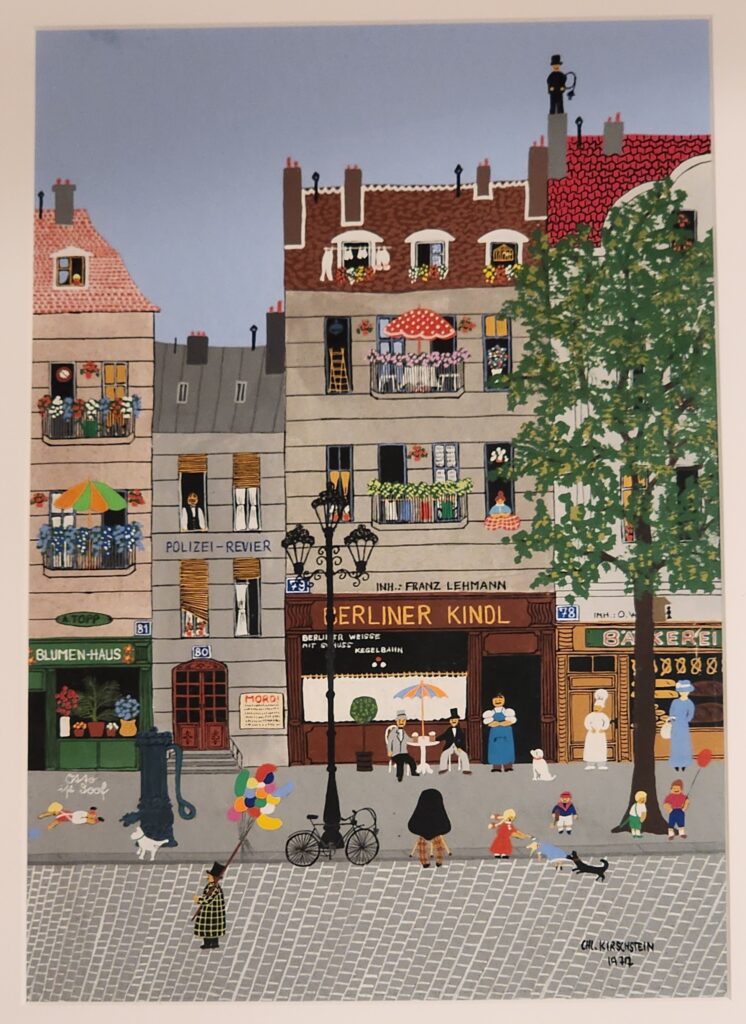
1. Untitled (Berlin Street Scene), 1977 — Leno Collection. A dense, cobblestoned Berlin street crowded with figures, animals, and shop fronts (a Berliner Kindl beer hall under the proprietor “Franz Lehmann,” a Polizei-Revier, a Blumen-Haus, a Bäckerei), with a chimney sweep on a rooftop and a cat in the foreground. Signed and dated lower right, CHL. KIRSCHSTEIN 1977. It is the earliest securely dated independent work in the collection, made five years after Erhard’s death.
2. California Café, 1987 — Leno Collection. A tall, narrow view of “Grainger’s California Café” at street number 6, with a red-and-white striped awning, café tables, window boxes, a chimney sweep on the roof, and, across the façade, a banner reading 750 JAHRE BERLIN. Signed and dated CHL. KIRSCHSTEIN 1987. The banner ties the work precisely to Berlin’s 750th-anniversary year, 1987; the location of “Grainger’s California Café” within West Berlin has not yet been confirmed, and the Americanised name is itself a small document of West Berlin’s Allied-era street culture.
3. Eulen (Owls), 1985 — not in the collection; documented via a German eBay listing (seller “stadtrandluft,” Königs Wusterhausen). Two adult eagle owls flank a row of owlets on a leafy branch; a naïve but carefully rendered decorative animal subject, signed and dated lower left. It demonstrates that Kirschstein’s practice was not confined to topographical city scenes.
A recurring chimney-sweep motif links the 1977 and 1987 works. In German popular culture the Schornsteinfeger is a traditional emblem of good luck, and its appearance is consistent with the greeting-card idiom in which much of Kirschstein’s imagery circulated; the motif is noted here as an observed and repeated compositional element, without any stronger claim about authorial intention.
Two further works appear in earlier project documentation — a “winter skating village scene” dated 1978 and a “Dahlem-Dorf U-Bahn station scene” — but these rest on less secure sourcing and are not independently verified. The “1978” in particular should be treated with carefully: Lichtenrade-Berlin.de carries a photograph captioned as showing “Ch. Kirschstein (1978) beim Malen” — that is, a 1978 photograph of the artist at work — which is a plausible origin for a mistaken 1978 artwork entry. These items are recorded here only as unconfirmed references.
On medium: the collection’s naïve paintings have not yet been examined in the hand for technique; the works are visually consistent with opaque watercolour or gouache on paper, but medium and exact dimensions await physical inspection and should not be stated as settled.
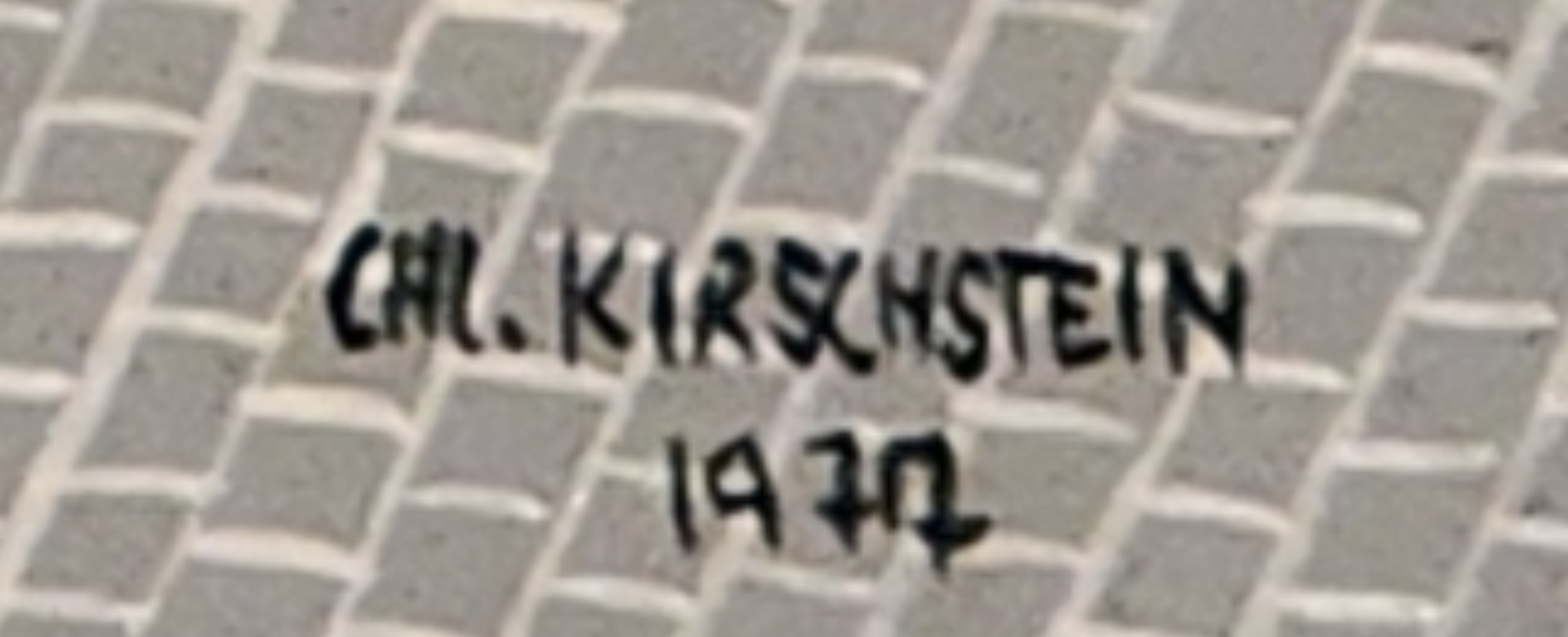
On signature: the authenticated signature form is CHL. KIRSCHSTEIN — in capitals, with the abbreviation “CHL.” This signature is confirmed across the two dated paintings in our collection. (Secondary text sources, including Wikipedia, refer to her in prose as “Ch. Kirschstein,” which is a bibliographic abbreviation, not her signing form.) Works signed in a materially different manner should be approached with caution before attribution until more examples are observed.
Death, burial, and estate
Charlotte Kirschstein died on November 27, 2013, per the Ruhr Nachrichten death notice of November 29, 2013. (The German Wikipedia entry has not been updated to record her death — a further indication of how sparse the published record is.) She was buried at the Alter Parkfriedhof Lichtenrade (Paplitzer Straße 10, 12307 Berlin); the grave lease is documented as valid until 2037 and the plot is maintained by a grandson. Her burial in Berlin, notwithstanding the family’s Westphalian (Olfen) address in the death notice, indicates continuing Berlin ties; whether Charlotte herself relocated to Olfen late in life is not established. By contrast, Erhard’s own grave in Lichtenrade lapsed and was reused in 1997, leaving no surviving site — so the maintained Lichtenrade plot is now the sole physical memorial associated with either artist.
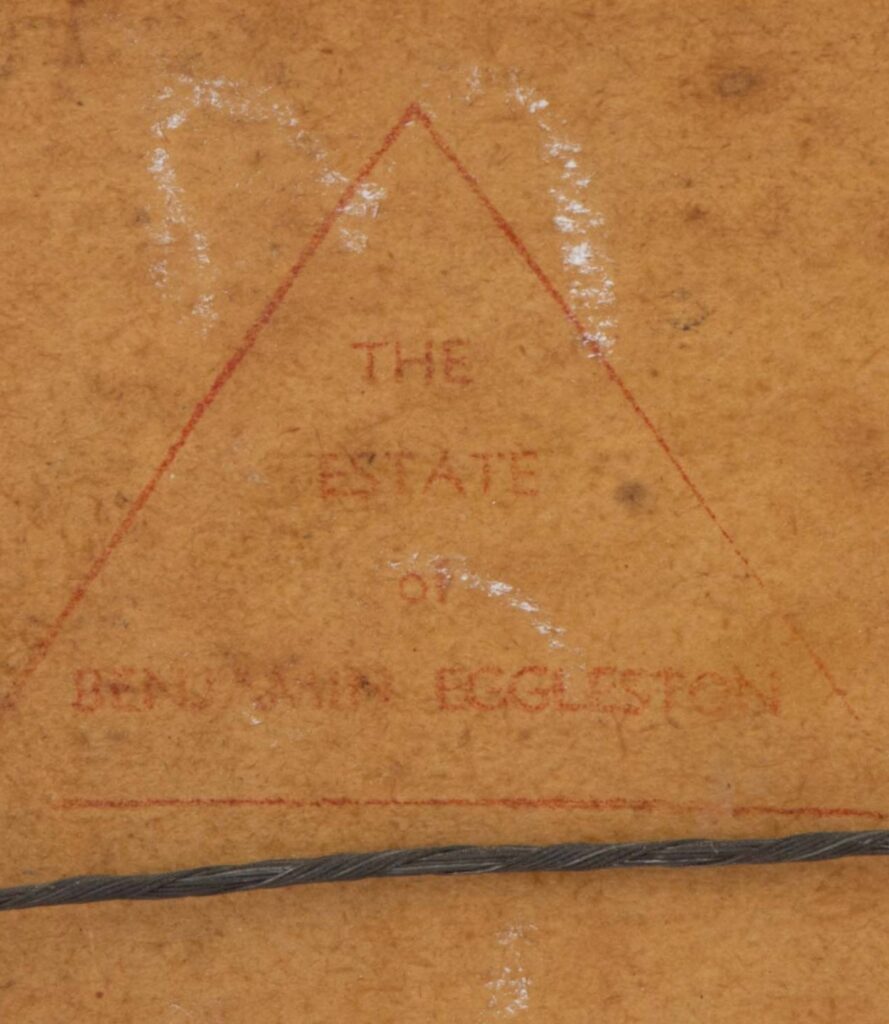
Under German law her authorial rights subsist for seventy years after death and are expected to expire in 2083 (Erhard’s in 2042). The rights are held directly by her descendants; they are not administered by VG Bild-Kunst. Access to certain records — her burial register entry and her sealed civil birth record — is further restricted by statutory protection periods, the latter until roughly 2034.
Assessment
Charlotte Kirschstein was a self-taught naïve painter of Berlin whose independent public career, though modest in institutional terms, was sustained: a twenty-two-year presence at the Harnack-Haus, gallery representation on the Kurfürstendamm, press notice, bank patronage, and a card-publishing relationship that carried more than fifty of her images into wide domestic circulation. Within the frame of the Leno Collection’s project, her work stands in deliberate counterpoint to Erhard’s. Where his lithographs register the divided city with observational restraint — ruin, memorial, empty street — hers reconstruct a warmer, idealised, narrative Berlin in a folk idiom: remembered rather than witnessed. Read together, the two bodies of work constitute a dual record of the same city and household, one documentary and one mnemonic.
That reading is the collection’s interpretive thesis rather than an established art-historical judgement, and it should be presented as interpretation. What can be asserted without qualification is narrower and, for a figure with virtually no scholarly footprint, more valuable: that Charlotte Kirschstein was a real, dated, signing, exhibiting Berlin artist whose oeuvre is at present preserved chiefly in private hands and in ephemeral commercial reproduction, and whose biography still turns on a small number of civil records that remain, for now, closed.
Sources
Primary and quasi-primary
- Ruhr Nachrichten, death notice, November 29, 2013 (“Charlotte Kirschstein, geb. Budek”): maiden name; death date (November 27, 2013); birth date April 7, 1924; family names; Olfen address. Family/funeral-home authored.
- The signed, dated works themselves: Untitled (Berlin Street Scene), 1977, and California Café, 1987 (both Leno Collection); Eulen, 1985 (documented via eBay listing, seller “stadtrandluft,” Königs Wusterhausen, item no. 284462467289).
- Burial record / cemetery documentation, Alter Parkfriedhof Lichtenrade (Paplitzer Straße 10, 12307 Berlin): burial 2013; lease to 2037.
Secondary (note: both derive from the family informant Andreas Schulz and contain at least one confirmed error each)
- German Wikipedia, “Charlotte Kirschstein” (de.wikipedia.org): naïve style; subjects; exhibition history (Harnack-Haus 1972–1994; Galerie Brigitte Wölffer 1983–1987; Theater am Kurfürstendamm thereafter); Plischke-Kunst-Verlag (50+ motifs); second marriage to Erhard; birth date July 6, 1924. Errors: no death recorded; Erhard’s birth date given as April 18, 1920 (correct: April 20, 1920).
- Lichtenrade-Berlin.de, “Charlotte Kirschstein” (persoenlichkeiten / kuenstler): residences; postwar turn to painting via military-button piecework; Plischke connection via the Bahnhofstraße shop; Berliner Morgenpost feuilleton (Christmas 1985); Berliner Bank brochure (1984); worldwide dispersal via Allied personnel; birth date July 6, 1924; informant credited as nephew Andreas Schulz. Contains a 1978 photograph of the artist painting, a likely source of the spurious “1978 artwork” reference.
Not yet consulted / restricted
- Civil birth register (Geburtseintrag), Berlin — sealed until c. 2034; would resolve the birth-date discrepancy.
- Marriage record (Heiratseintrag), Charlotte Budek / Erhard Kirschstein, c. 1946–1955 — request directed to Standesamt Tempelhof-Schöneberg / Landesarchiv Berlin; outstanding.
- Berliner Morgenpost feuilleton profile of the 1980s — cited secondhand as the ultimate source of the July 6, 1924 date; not directly examined.
- Standesamt Tempelhof-Schöneberg — first-marriage and Werner-parentage questions; not yet initiated.
- Plischke-Kunst-Verlag, Unterwössen — publisher records of the card motifs; not yet approached.
Principal open questions
- Birth date — April 7 vs. July 6, 1924; resolvable only via the sealed civil record (c. 2034) or an intervening baptismal/parish record.
- First marriage and Werner’s parentage — identity and fate of any first husband; date of marriage to Erhard; whether Werner (1949–2016) was Erhard’s son, a son of an earlier union, or adopted. Werner’s surname complicates the current working hypothesis.
- Charlotte’s role in Erhard’s print workshop — the two-hands signature evidence is suggestive but uncorroborated.
- The card corpus — over fifty Plischke motifs are documented in the aggregate; none has yet been examined individually.
- Medium and dimensions of the collection paintings — awaiting physical examination.
- “Grainger’s California Café” — its actual West Berlin location.